
SOF IMO Class 2 sample paper — with hints and explanations
A full SOF IMO-style maths sample paper for Class 2 — 35 questions across number sense, times tables, fractions, time, money, shapes and reasoning. It takes about 40 minutes, and there is nothing to sign up for.
This is the Talyzo way of practising. As a free bonus, every question here carries a hint before the answer and a full explanation after, so you can solve it together. A wrong answer is not the end — it is the moment your child learns something. Let them try first, reveal the hint only if they are stuck, and read the explanation together even when they got it right.
Prefer paper? Download the PDF (11 pages, questions then a full answer key), or press Ctrl + P — this page is built to print cleanly with every hint, answer and explanation shown.
How to use this paper
- Sit with your child, but don't hover.
- Let them try before revealing the hint.
- Read the explanation together even when they got it right.
- No timer the first time through.
Section A — Logical reasoning & mathematical reasoning
-
Q1. What number lies between 612 and 622?
Hint
A number between two numbers is bigger than the first and smaller than the second. Which option is more than 612 and less than 622?
Answer & explanation
Answer: B) 615. 615 is greater than 612 and less than 622, so it lies between them.
-
Q2. Which of the following is equal to 4 + 12 + 9?
Hint
First add the three numbers to find the total. Then work out each option and see which one makes the same total.
Answer & explanation
Answer: A) 16 + 9. 4 + 12 + 9 = 25 and 16 + 9 also equals 25, so they are the same.
-
Q3. Which option is same as two hundred?
Hint
Two hundred is 200. Remember that 10 tens make 100. Work out what each option comes to.
Answer & explanation
Answer: B) 10 tens 10 tens. 10 tens + 10 tens = 100 + 100 = 200, which equals two hundred.
-
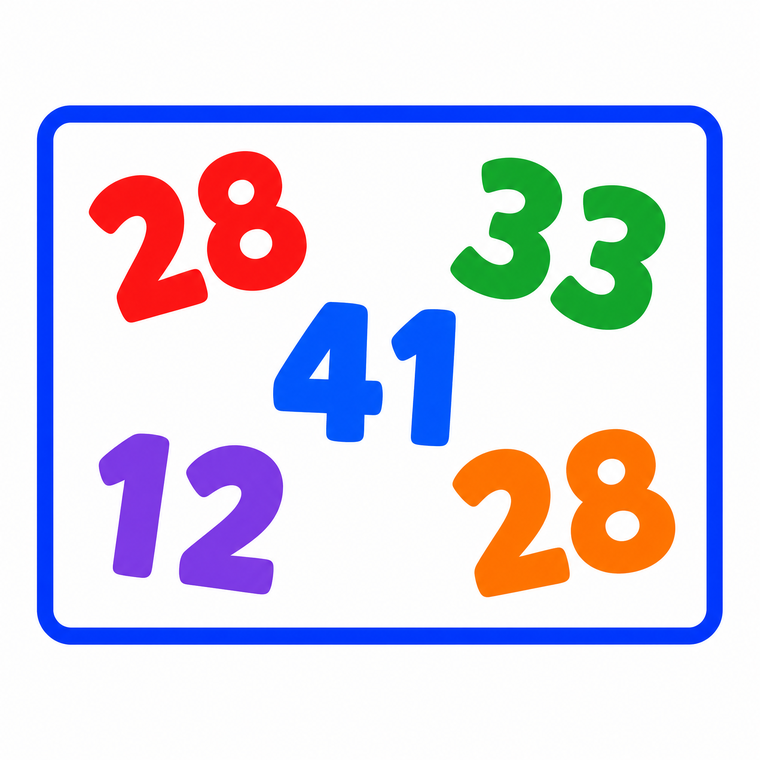
Q4. Find out the sum of the numbers given inside the rectangle.
Hint
Add the five numbers one step at a time. Adding them in pairs first can make it easier to keep track.
Answer & explanation
Answer: B) 142. Adding all the numbers inside the rectangle: 28 + 33 + 41 + 12 + 28 = 142.
-
Q5. A spider has 8 legs. How many legs do 5 spiders have?
Hint
Five spiders, each with 8 legs. Add 8 five times, or count in eights: 8, 16, 24…
Answer & explanation
Answer: B) 40. Each spider has 8 legs, so 5 spiders have 5 × 8 = 40 legs.
-
Q6. Which one of the following is correct for 728?
Hint
Split 728 into hundreds, tens and ones. Which digit sits in each place?
Answer & explanation
Answer: A) 7 hundreds + 2 tens + 8 ones. 728 means 7 hundreds, 2 tens and 8 ones, so 700 + 20 + 8 = 728.
-
Q7. 4 × 2 × 6 = ?
Hint
Do it in two steps. Multiply the first two numbers, then multiply that answer by the last number.
Answer & explanation
Answer: A) 48. 4 × 2 = 8 and 8 × 6 = 48.
-
Q8. 60 has the same value as:
Hint
Add each pair and check which one comes to exactly 60.
Answer & explanation
Answer: C) 30 + 30. 30 + 30 = 60, which is the same as 60.
-
Q9. Select the correct option to fill in the blank. 8 × 5 = ...... + 5 + 5 + 5 + 5 + 5 + 5 + 5
Hint
8 × 5 means eight 5s added together. Count how many 5s are already shown after the blank, then work out what is left.
Answer & explanation
Answer: A) 5. 8 × 5 means eight 5s, which is 40. After the blank there are seven 5s (5+5+5+5+5+5+5 = 35). So the blank must be 40 − 35 = 5.
-
Q10. Fill in the blank. 40 multiplied by 10 is ...... 4 multiplied by 100.
Hint
Work out both sides. What is 40 × 10? What is 4 × 100? Then compare them.
Answer & explanation
Answer: C) equal to. 40 × 10 = 400 and 4 × 100 = 400, so both are equal.
-
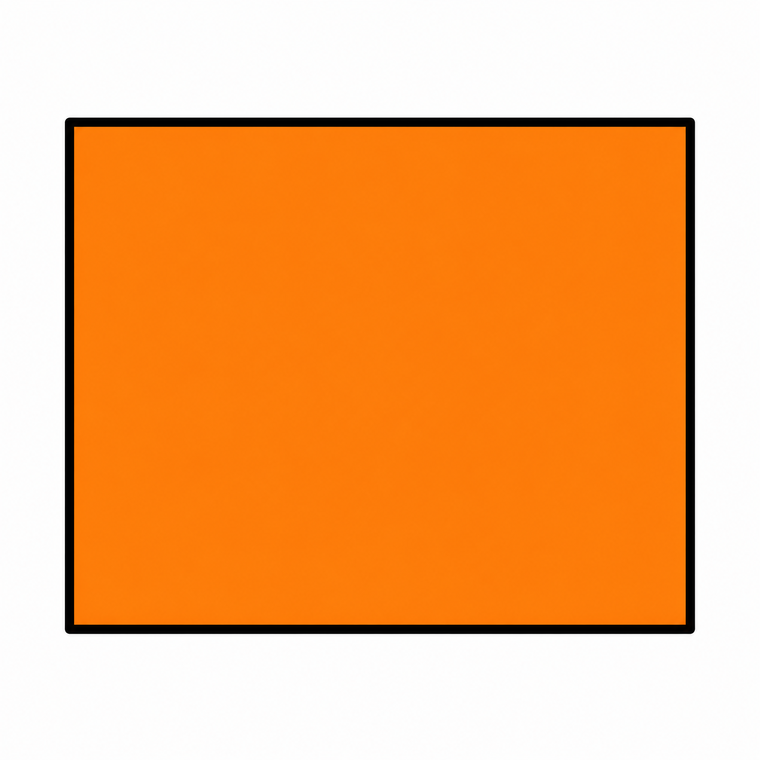
Q11. How many corners does this shape have?
Hint
Corners are the points where two sides meet. Trace the shape with your finger and count each point.
Answer & explanation
Answer: A) 4. A rectangle has 4 corners.
-
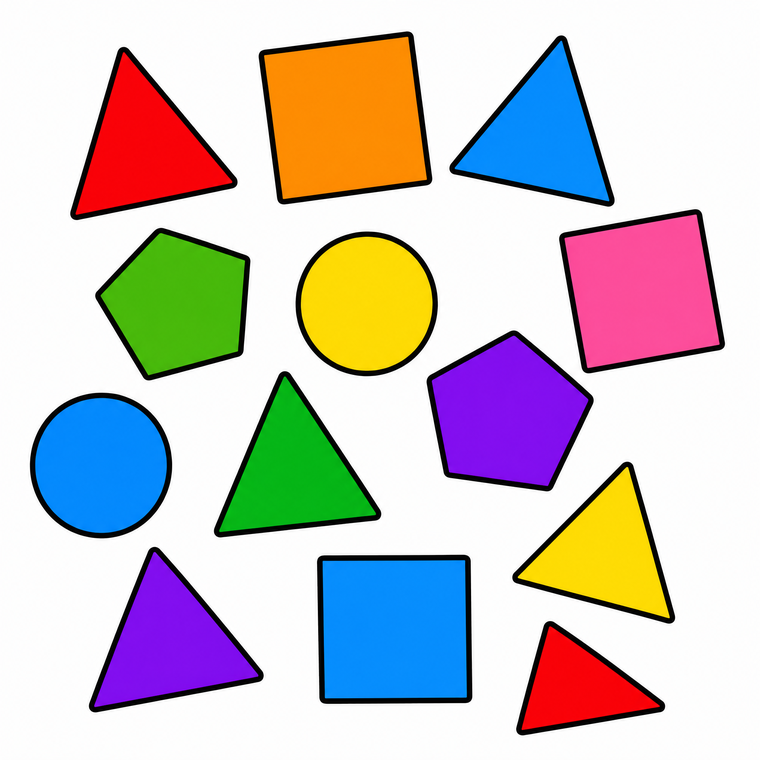
Q12. How many triangles are there in the below image?
Hint
Look carefully — some triangles are tucked between the others. Count slowly so you do not miss any.
Answer & explanation
Answer: D) 6. Count the triangles carefully. There are 6 triangles in the image.
-
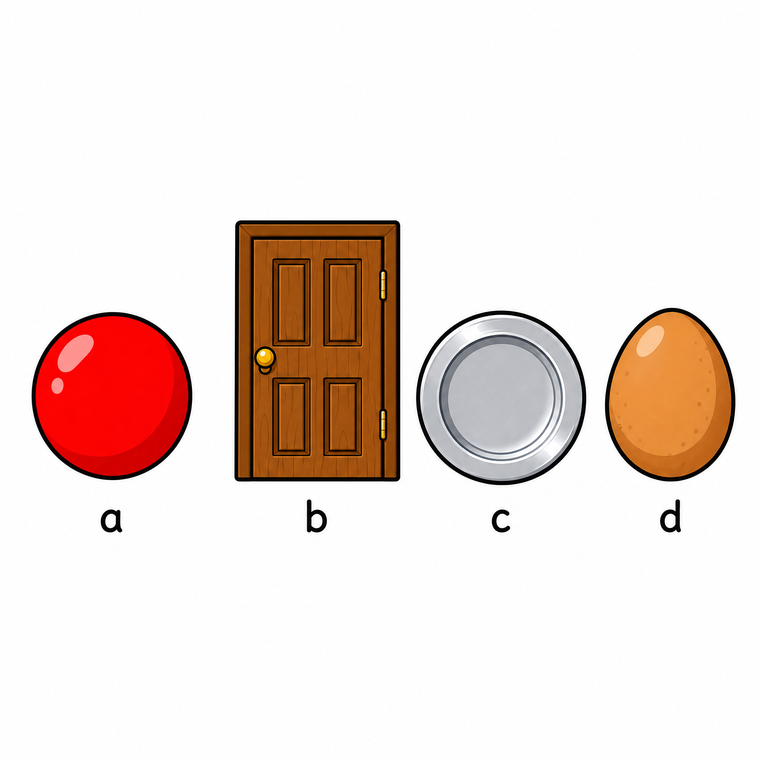
Q13. Which of the following has the shape of a rectangle?
Hint
Think about which object has straight sides and square corners, like a book.
Answer & explanation
Answer: B) door. A door has a rectangular shape.
-
Q14. The weight of a watermelon can be measured in:
Hint
Weight is how heavy something is. Which unit do we use for heavy things — the same one we use for vegetables at the market?
Answer & explanation
Answer: C) kg. Weight is measured in kilograms (kg), and a watermelon is measured in kg.
-
Q15. 180 seconds is equal to:
Hint
Remember 1 minute = 60 seconds. How many 60s fit into 180?
Answer & explanation
Answer: C) 3 minutes. 1 minute = 60 seconds, so 180 ÷ 60 = 3 minutes.
-
Q16. Ravi's piano class starts at 3:00 p.m. and finishes at 4:30 p.m. How long does he learn piano?
Hint
Count on from 3:00. How far is it to 4:00, and then to 4:30?
Answer & explanation
Answer: B) One hour 30 minutes. From 3:00 p.m. to 4:30 p.m. is 1 hour and 30 minutes.
-
Q17. Which is the smallest?
Hint
All the lengths are in cm, so just compare the numbers. Which number is the smallest?
Answer & explanation
Answer: A) 5 cm. 5 cm is the smallest length among the given options.
-
Q18. What time does the clock show in the figure below?
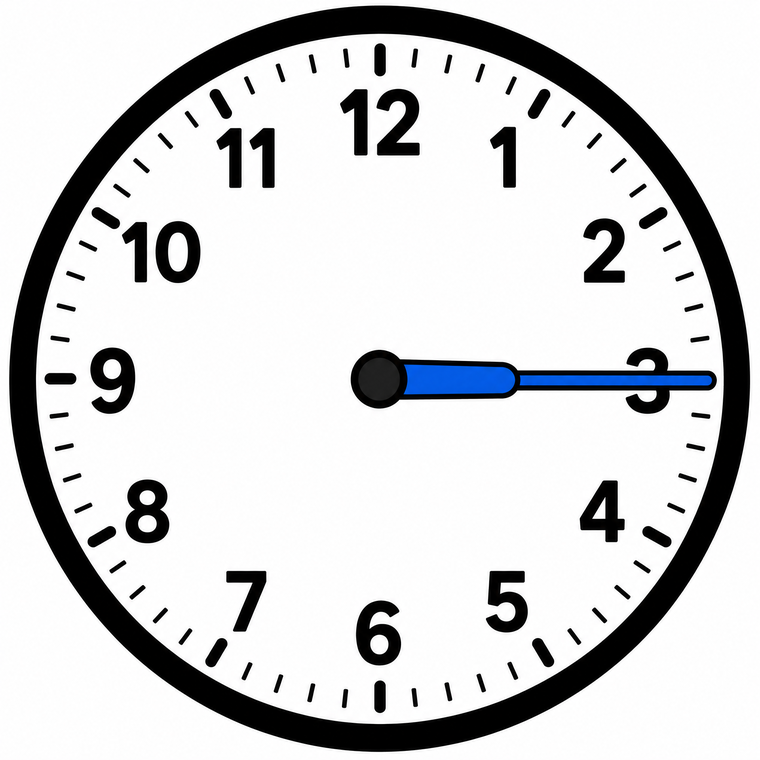
Hint
Look at where the short hand (hour) points, and where the long hand (minute) points.
Answer & explanation
Answer: B) 3:00. On this clock the short hour hand points to 3 and the long minute hand points to 12, so the time is 3 o'clock, written 3:00.
-
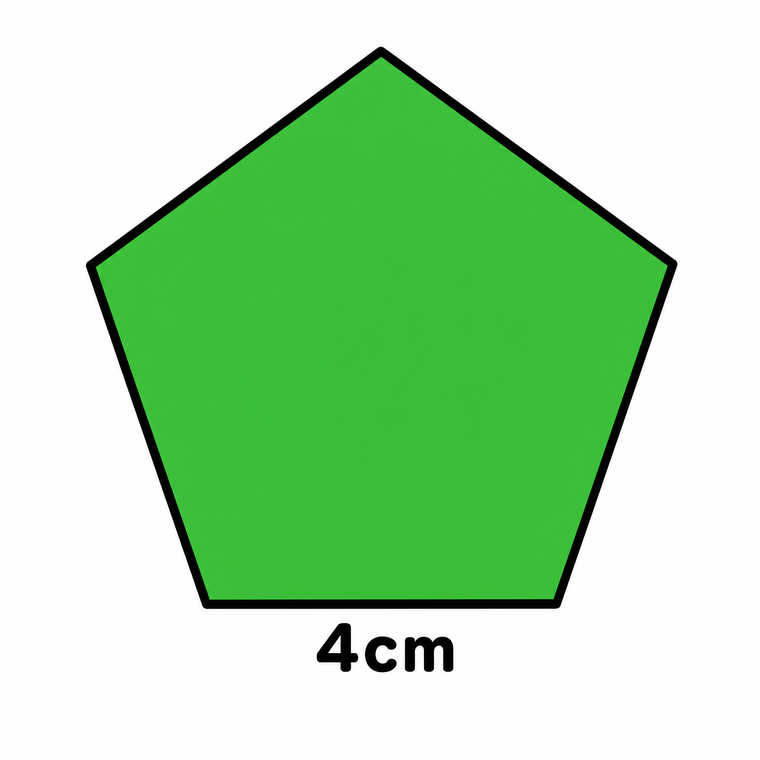
Q19. Each side of the given figure is 4 cm long. What is the length of wire needed to form this figure?
Hint
First count how many sides the shape has. Then add the 4 cm for each side.
Answer & explanation
Answer: A) 20 cm. A pentagon has 5 sides. Each side is 4 cm, so 5 × 4 = 20 cm of wire is needed.
-
Q20. ₹ 100 note is equal to ........ ₹ 10 notes.
Hint
How many ₹10 notes make ₹100? Count in tens up to 100.
Answer & explanation
Answer: C) Ten. 100 ÷ 10 = 10, so ₹ 100 equals ten ₹ 10 notes.
-
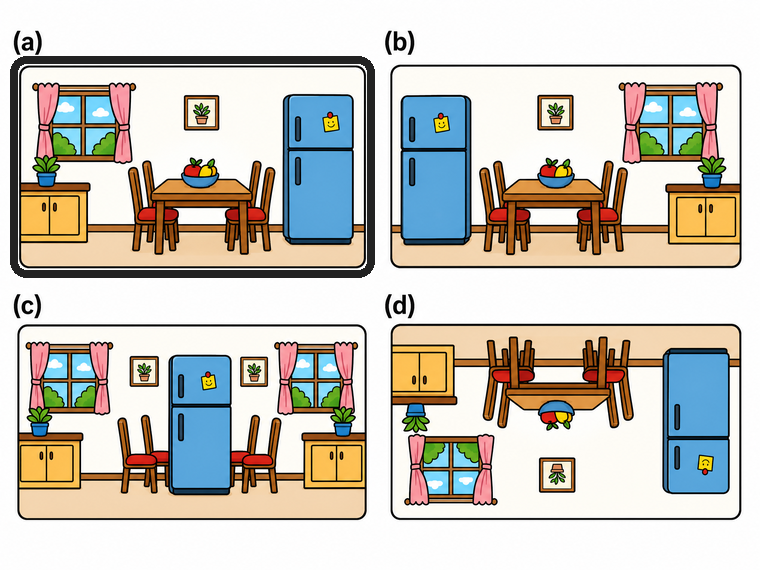
Q21. Find the mirror image for the following image:
Hint
A mirror image is flipped left-to-right, as if you held it up to a mirror. Which option is the exact reflection?
Answer & explanation
Answer: A) Option (a). A mirror image is the exact reflection of the original image flipped horizontally.
-
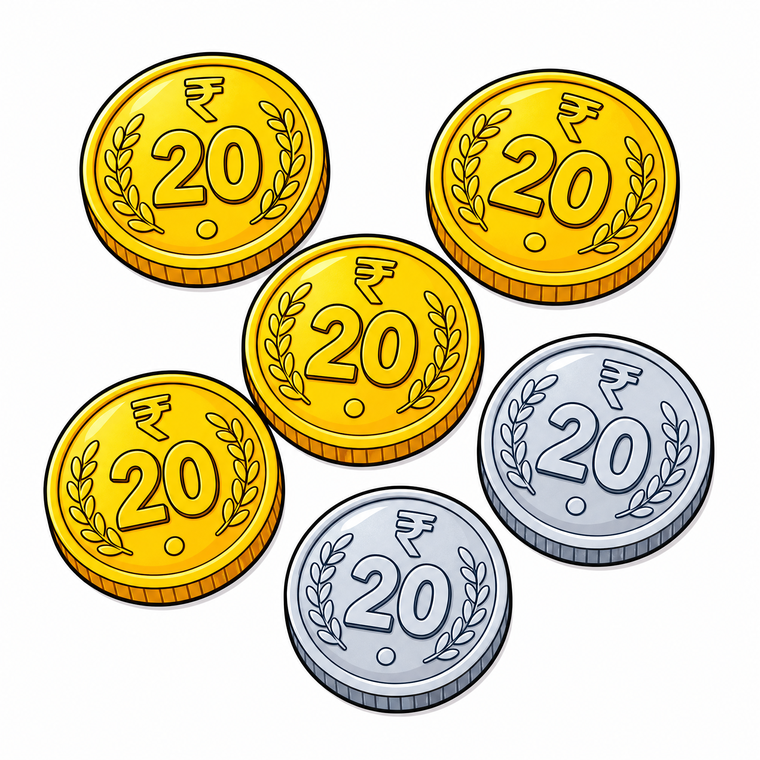
Q22. What is the total amount of money shown below?
Hint
Count how many coins there are and what each one is worth, then add them up.
Answer & explanation
Answer: A) ₹ 120. Adding the coins shown in the image gives ₹ 120.
-
Q23. Priya has 4 coins of ₹ 5 and 2 coins of ₹ 1. How much money does Priya have?
Hint
Work out the ₹5 coins together, then the ₹1 coins, then add the two amounts.
Answer & explanation
Answer: A) ₹ 22. 4 × ₹ 5 = ₹ 20 and 2 × ₹ 1 = ₹ 2, so total = ₹ 20 + ₹ 2 = ₹ 22.
-
Q24. What is the numerator of the fraction 2/9?
Hint
The numerator is the top number of a fraction. Which number is on top in 2/9?
Answer & explanation
Answer: B) 2. In the fraction 2/9, the top number 2 is called the numerator.
-
Q25. The denominator of a fraction is 4. What can be the possible fraction?
Hint
The denominator is the bottom number. Which option has 4 on the bottom?
Answer & explanation
Answer: B) 3/4. In 3/4, the bottom number (denominator) is 4, which matches the question.
-
Q26. What fraction of the given shape is shaded?
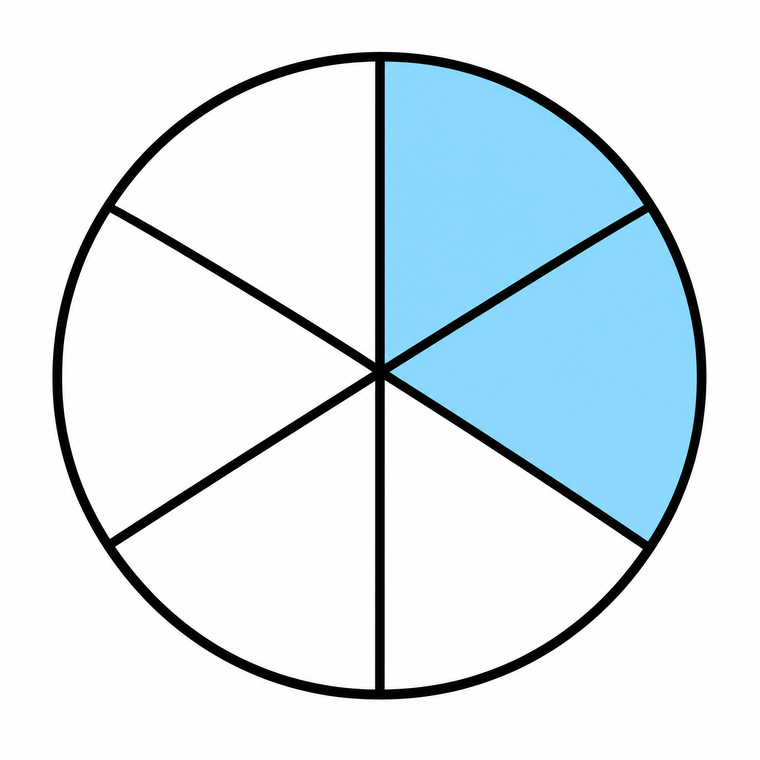
Hint
Count the total number of equal parts, then count how many are shaded.
Answer & explanation
Answer: A) 2/6. Out of 6 equal parts, 2 parts are shaded, so the fraction is 2/6.
-
Q27. Complete the below number pattern. 5, 9, 14, ......, 27, 35
Hint
Look at how much is added each step: 5 to 9, then 9 to 14… does the jump grow each time?
Answer & explanation
Answer: C) 20. The pattern adds 4, then 5, then 6, then 7, then 8. So 5+4=9, 9+5=14, 14+6=20, 20+7=27, 27+8=35. The missing number is 20.
-
Q28. Complete the analogy given below: CAT : 030120 :: DOG : ?
Hint
Each letter is swapped for its position in the alphabet (A=1, B=2…). Find the positions of D, O and G.
Answer & explanation
Answer: A) 041507. Each letter is replaced by its position in the alphabet. D=4, O=15, G=7, so DOG = 041507.
-
Q29. Which team scored the maximum points? Direction (Q. 29 to 30): Read the following data carefully and choose the best option. | Teams | A | B | C | D | |---|---|---|---|---| | Points | 45 | 32 | 50 | 28 |
Hint
Compare the points for each team. Which number is the biggest?
Answer & explanation
Answer: C) Team C. Team C scored 50 points which is the highest among all teams.
-
Q30. What is the difference between the points scored by Team A and Team D?
Hint
Find Team A's points and Team D's points, then take the smaller away from the bigger.
Answer & explanation
Answer: B) 17. Team A scored 45 and Team D scored 28, so 45 - 28 = 17.


Achievers section
Two-mark questions that reward careful, step-by-step thinking.
-
Q31. Which one of the following is true for 84?
Hint
Split 84 into tens and ones. How many tens and how many ones?
Answer & explanation
Answer: A) 8 tens + 4 ones. 84 means 8 tens and 4 ones, which is 80 + 4 = 84.
-
Q32. Anju has a basket that contains red, blue and green apples as shown below. What fraction of the total apples are red?

Hint
Count the total number of apples first, then count only the red ones.
Answer & explanation
Answer: A) 4/10. Count the total apples and the red apples. 4 out of 10 apples are red, so the fraction is 4/10.
-
Q33. Meera spent half an hour in the library. She spent another 1 hour in the garden. She came out of the garden at 15 minutes past 3 p.m. At what time was she in the library?
Hint
Add up the time she spent altogether, then count back from when she came out.
Answer & explanation
Answer: B) 1:45 p.m.. Total time spent = 1 hour + 30 minutes = 1 hour 30 minutes. She came out at 3:15 p.m., so she started at 3:15 - 1:30 = 1:45 p.m.
-
Q34. A fraction has 3 as numerator and 6 as denominator. It means that whole part is:
Hint
The bottom number tells how many equal parts the whole is cut into; the top number tells how many are taken.
Answer & explanation
Answer: B) divided into 6 parts and 3 parts are taken. The denominator 6 means the whole is divided into 6 equal parts, and the numerator 3 means 3 parts are taken.
-
Q35. Complete the following pattern. Look at the image below and choose the correct option.
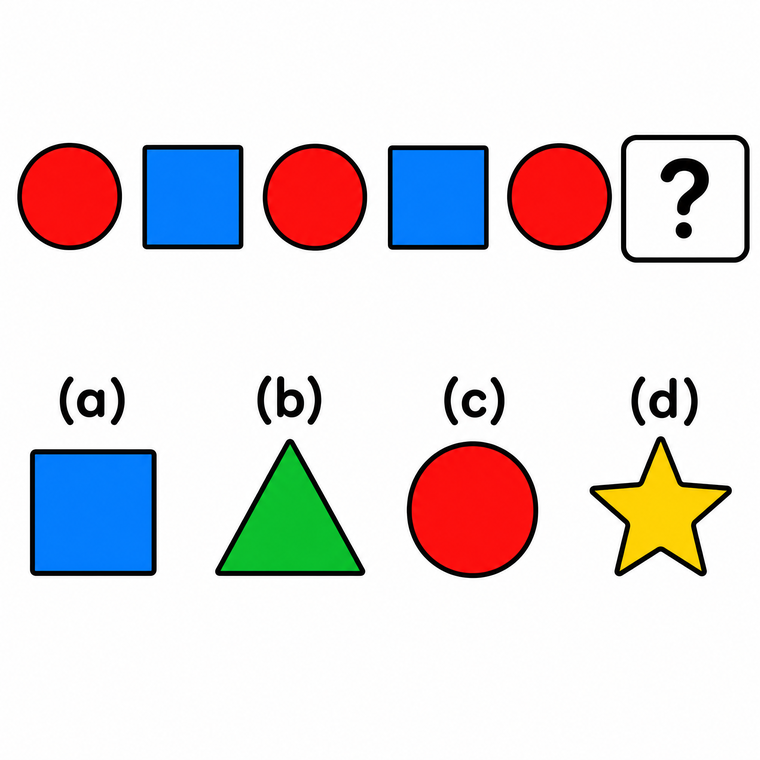
Hint
Find the part of the pattern that keeps repeating, then see which shape comes next.
Answer & explanation
Answer: A) Square (blue). The pattern repeats circle (red) and square (blue). After circle, the next shape is square (blue).


Answer key
Each topic links to a free Talyzo guide for practice.
How your child did
- All or nearly all correct — they're ready. Stretch them with the full course.
- About half — completely normal for Class 2. Use the answer key above to see which topics to practise next.
- A few correct — start with number sense. Our free Class 2 maths guides take one idea at a time.
No scores, no percentiles, no levels — just the next helpful step.
Free account, no card required.
← All sample papers